United States · USD · ft / in
United States · ACI 318

Concrete Calculator

Cubic yards, bags, rebar, and cost for slabs, footings, columns, and stairs. Reviewed by a licensed US civil engineer.

Estimator · v3.2 · US

Readout

Order this muchcu yd
Cubic meters
Volumeft³
80 lb bags
60 lb bags
Rebar #4 @ 12"ft
Cost

From dimensions to a ready-mix order.

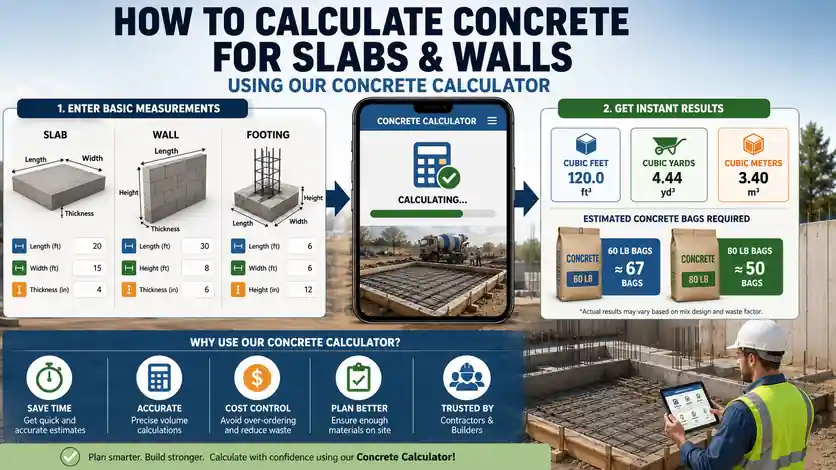
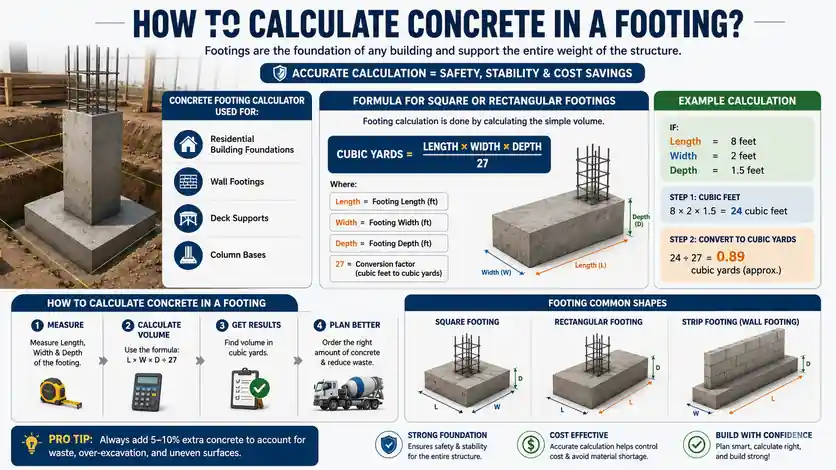
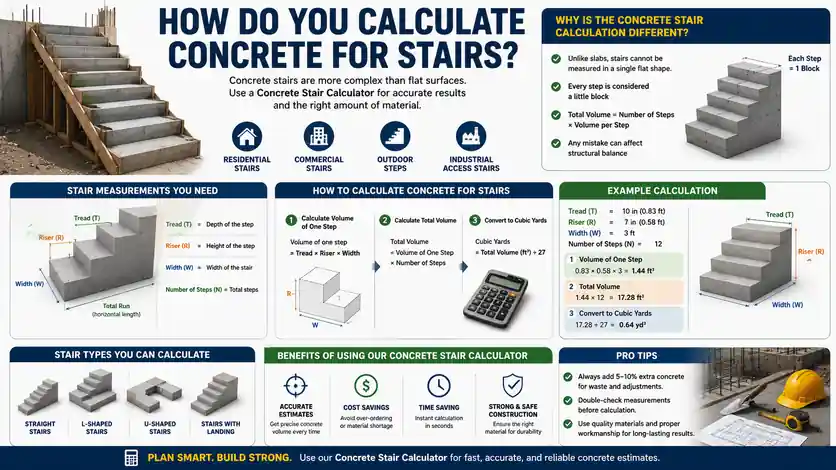
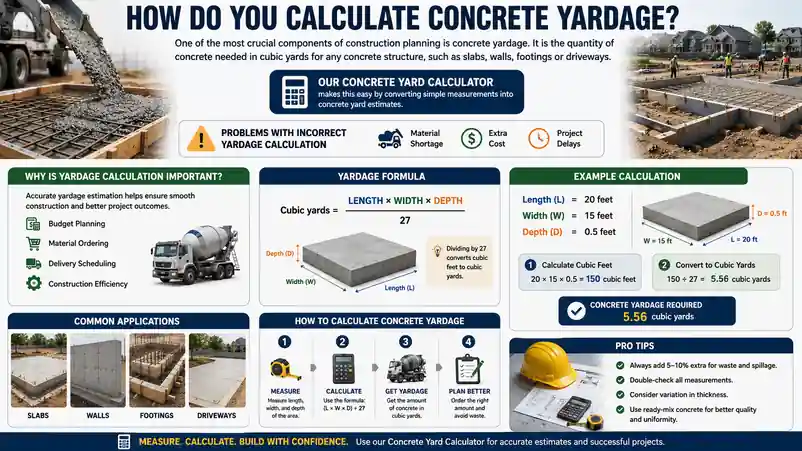
Volume is length × width × thickness. The supplier conversion you need is 27 cubic feet per cubic yard. For round columns, the tool uses π × radius² × height. For stairs, it figures each step as a stacked rectangle and adds them up — the right method for poured stairs, not the triangle shortcut.

A waste factor of 5% to 10% is added to the raw volume. This covers spillage, over-excavation, and uneven subgrade. Eight percent is typical for residential flatwork; ten for hand-dug footings or rough ground. Plants sell in quarter-yard steps, so the figure is rounded up to the next 0.25 cubic yard.

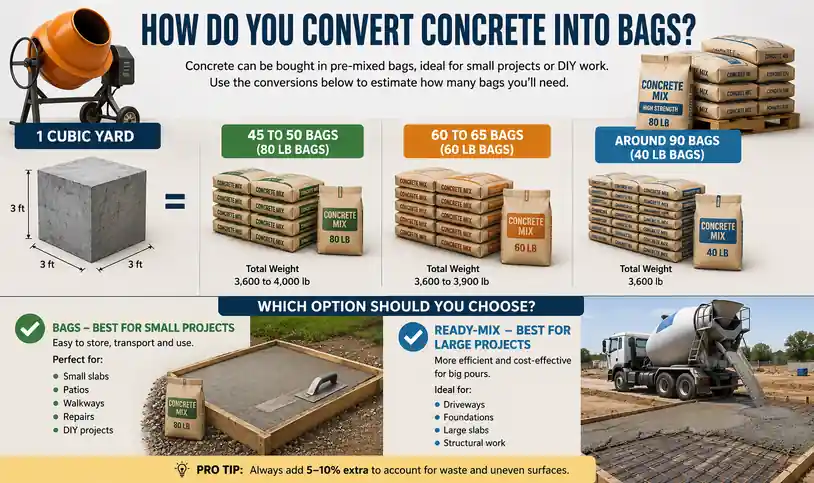
Bag counts use the printed yields: 60 lb bags at ~0.45 ft³, 80 lb bags at ~0.60 ft³. The rebar estimate assumes #4 bar at 12 inches on center each way — the residential default in ACI 332.

Match the mix to the job.

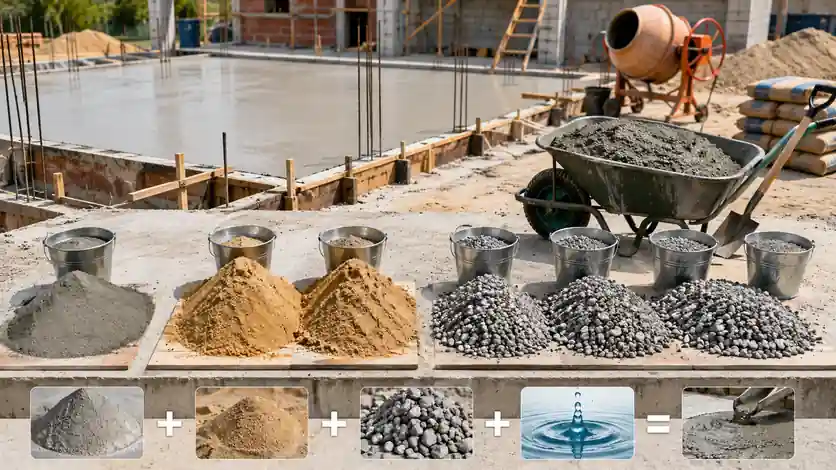
Order concrete by compressive strength (psi), not by aggregate ratio. The ratios below are nominal; your ready-mix supplier proportions the actual mix to hit the psi on the delivery ticket.

Concrete mix strengths and use cases
Mix Ratio28-Day StrengthTypical UseReference
1 : 3 : 6~ 2,200 psiMass fill, non-structural padsACI 211
1 : 2 : 4~ 2,500 psiLight footings, garden wallsACI 332
1 : 1.5 : 3~ 3,000–3,500 psiHouse slabs, sidewalksACI 332
1 : 1 : 2~ 4,000 psiDriveways, garage slabsACI 318
Engineered4,500+ psiStructural columns, commercialACI 318

In freeze-thaw climates, specify air-entrained concrete at 5–7% entrained air. ACI 318 requires it for exposure class F2 — surfaces exposed to moisture and freezing.

How thick should the slab be?

Slab thickness drives both the concrete order and the load capacity. These are the minimums most US municipal inspectors accept for slab on grade, per ACI 332 residential guidance.

4 in Sidewalks, patios, residential car driveways. 3,000 psi mix, fiber mesh or #4 @ 18" o.c.
5 in Heavy car driveway, light truck use. 3,500 psi with #4 rebar at 12" o.c. each way.
6 in Trucks, RVs, trailers, garage with workshop. 4,000 psi mix, #4 or #5 rebar.
8 in Commercial and industrial. 4,500+ psi, engineered reinforcement schedule required.

Footing depth is set by your local frost line — typically 12 inches in the South, 42–48 inches across the upper Midwest and Northeast. Check with your building department before excavating; frost-heave damage isn't covered by any concrete spec.

Getting the strength you ordered.

Concrete hits its design strength at 28 days through hydration, not drying. Keeping the surface damp matters more than letting it "dry." Cover fresh pours with plastic sheeting or burlap for the first three to seven days. Foot traffic at 24 hours, light vehicles at seven days, full strength at 28.

For cold-weather pours below 40°F, ACI 306 calls for one or more of:

  • Heated mix water (raises batch temperature 10–15°F)
  • Accelerator admixture (calcium chloride or non-chloride)
  • Insulating blankets for the first 72 hours
  • Heated enclosure for placement below 25°F

Concrete that freezes before reaching about 500 psi loses durability permanently. Slump (workability) for typical residential flatwork lands between 4 and 5 inches. Higher slump pours easier but loses strength if extra water is the cause — request a plasticizer admixture instead.

Reviewed by Jordan Mireles, P.E. Licensed civil engineer · 14 years residential and light commercial concrete. Calculator logic and content checked against ACI 318-19, ACI 332-20, and ACI 306R-16. Last reviewed May 2026.

Quick answers.

How many bags of concrete in a cubic yard?

45 bags at 80 lb, or 60 bags at 60 lb. A cubic yard is 27 cubic feet; an 80 lb bag yields about 0.60 ft³. Above half a yard, ready-mix from a truck is cheaper than bagging it yourself.

How much concrete for a 10×10 slab?

1.23 cubic yards at 4 inches thick. With 8% waste, order 1.5 yards — plants sell in quarter-yard steps.

How thick should a driveway be?

4 inches for cars. 6 inches for trucks, RVs, or trailers. Use a 4,000 psi mix with rebar.

What psi concrete is used for a driveway?

3,500 to 4,000 psi for residential. Add air entrainment in freeze-thaw climates, per ACI 318 exposure class F2.

What waste factor should I use?

8% for typical residential work. 5% for clean forms on level ground. 10% for hand-dug footings or rough subgrade.

Bags or ready-mix delivery?

Under half a yard, bags are cheaper. Above that, ready-mix wins on price and labor. Most US plants charge a small-load fee under 3 yards.

Outside the US?